

A bursary is funding for your studies that you don’t have to pay back. It’s often offered by government departments, universities, trusts, large companies, or private organisations, and usually based on financial need and academic performance.
Start Early & Look for Opportunities
Begin searching months ahead of your study year — many bursaries open early and close between March and October for the following academic year.
Use bursary sites (e.g. ajiraforum, bursariesforum, NSFAS portal, university financial aid pages) and social media groups to find active opportunities.
Aim to apply to many bursaries, not just one, to increase your chances.
Check Eligibility Carefully
Each bursary has its own rules — these might include:
South African citizenship or permanent residence.
Field of study requirements (e.g., engineering, health).
Minimum academic grades (often 50–65% or above).
A proof of financial need (household income documents).
Make sure you only apply for bursaries where you meet the eligibility criteria.
Prepare Your Documents
Most bursaries require you to submit:
✔ Certified copy of your South African ID (or passport)
✔ Latest academic results (matric transcript or university marks)
✔ Proof of university/college acceptance or registration
✔ Proof of household income (parents’ payslips, affidavits, tax docs)
✔ Motivation or personal statement (why you need funding; your goals)
✔ CV / résumé (highlight leadership, community work, achievements)
✔ Reference letters (teachers, mentors, community leaders)
✔ Other specific documents depending on the bursary (e.g., research proposals for postgraduate awards)
Tip: Always use certified copies (signed by a commissioner of oaths) unless originals are explicitly requested.
Complete the Application Form
Many bursaries are now online applications (e.g., StudyTrust, university portals).
Some organisations still accept hard copies or emailed applications — read the instructions for each bursary carefully.
Fill every field honestly and double-check before submitting — incomplete or incorrect forms are often rejected.
Write a Strong Motivation Letter
Your personal statement helps you stand out. Focus on:
💡 Why you need financial support
💡 Your academic goals and career vision
💡 Achievements or challenges you’ve overcome
💡 How funding will help you and your community
Avoid generic text — tailor each letter to the specific bursary.
Submit Before the Deadline
Mark deadlines in your calendar and submit early, not last minute.
Save confirmation emails or reference numbers as proof you applied.
After You Apply
Many bursaries will email you if you’re shortlisted.
Some may require interviews or additional assessments.
If you don’t hear back after the closing period, assume your application was not successful (most bursaries publish outcomes after a set date).
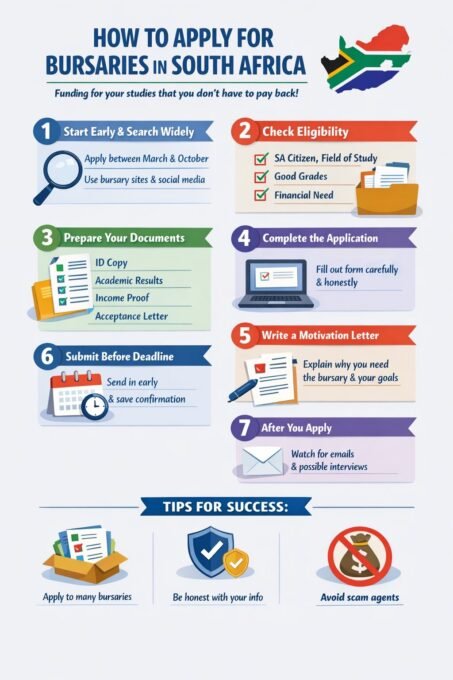
Extra Tips for Success
Apply to multiple bursaries (government, corporate, university, trust).
Keep everything honest and accurate — false info can lead to disqualification.
Avoid bursary “agents” asking for fees — legitimate bursaries are free to apply.